
Empirical SCOTUS: If Ginsburg were to leave the court, her departure might resemble Thurgood Marshall’s
Justice Ruth Bader Ginsburg’s wellbeing is in the news once more this 12 months. She announced previous thirty day period that she was being handled with chemotherapy — the fourth time considering the fact that 1999 that she has battled most cancers. After she was diagnosed with pancreatic most cancers in 2009, she resisted pressure to retire from the Supreme Courtroom below the Obama administration. With numerous clinic stays this 12 months and the most cancers recurrence, a lot of question how prolonged she will be in a position to stay on the court docket and no matter whether her tenure will outlast Donald Trump’s presidency. Some liberals go on to specific annoyance that Ginsburg did not retire below President Barack Obama.
Retirements and replacements at the court docket occur in various styles. A potential retirement by Ginsburg harkens again to Justice Thurgood Marshall’s retirement in 1991. Like Ginsburg, Marshall was a liberal chief on the court docket. Before becoming a member of the bench, Ginsburg launched the ACLU Women’s Rights Venture, and Marshall proven the NAACP Authorized Protection and Education and learning Fund. Marshall’s wellbeing was in decrease for the duration of the Reagan years, and after President George H.W. Bush was elected in 1988, he may have guessed he would have to have to step down just before the finish of the Bush presidency. Still, Marshall was recognized to fairly sarcastically confide to his clerks, “If I die, prop me up and hold on voting,” not wanting a conservative justice to be placed in his stead. In the finish, Marshall retired from the court docket with Bush continue to president in October 1991, citing wellbeing and age. He was replaced by Justice Clarence Thomas, who has grow to be 1 of the most conservative justices. The replacement of Marshall with Thomas was 1 of the greatest ideological shifts in a solitary seat.
An frequently-made use of metric to assess ideology on the court docket is Martin-Quinn scoring. Even though MQ scores do not immediately measure no matter whether a justice is liberal or conservative, they do measure justices’ voting agreements with each and every other by positioning all justices on the similar scale and bridging these agreement scores across time. The statistical modeler then needs to define a liberal-conservative dimension by deciding on a prototypic liberal and conservative justice to sit on both aspect of the axis. Because all justices are then on the similar scale, the MQ Scores are not just pairwise steps amongst two justices.
MQ scores are fairly arbitrary in magnitude, but they have hardly ever exceeded good 10 for conservative justices or negative 10 for liberal justices. These bookends are meant to offer some sense of the scores’ normal variety, which is significant in a relativistic sense. Most importantly, related MQ scores necessarily mean that justices are closely aligned in their voting, when increased distance amongst scores implies that two justices frequently disagree.
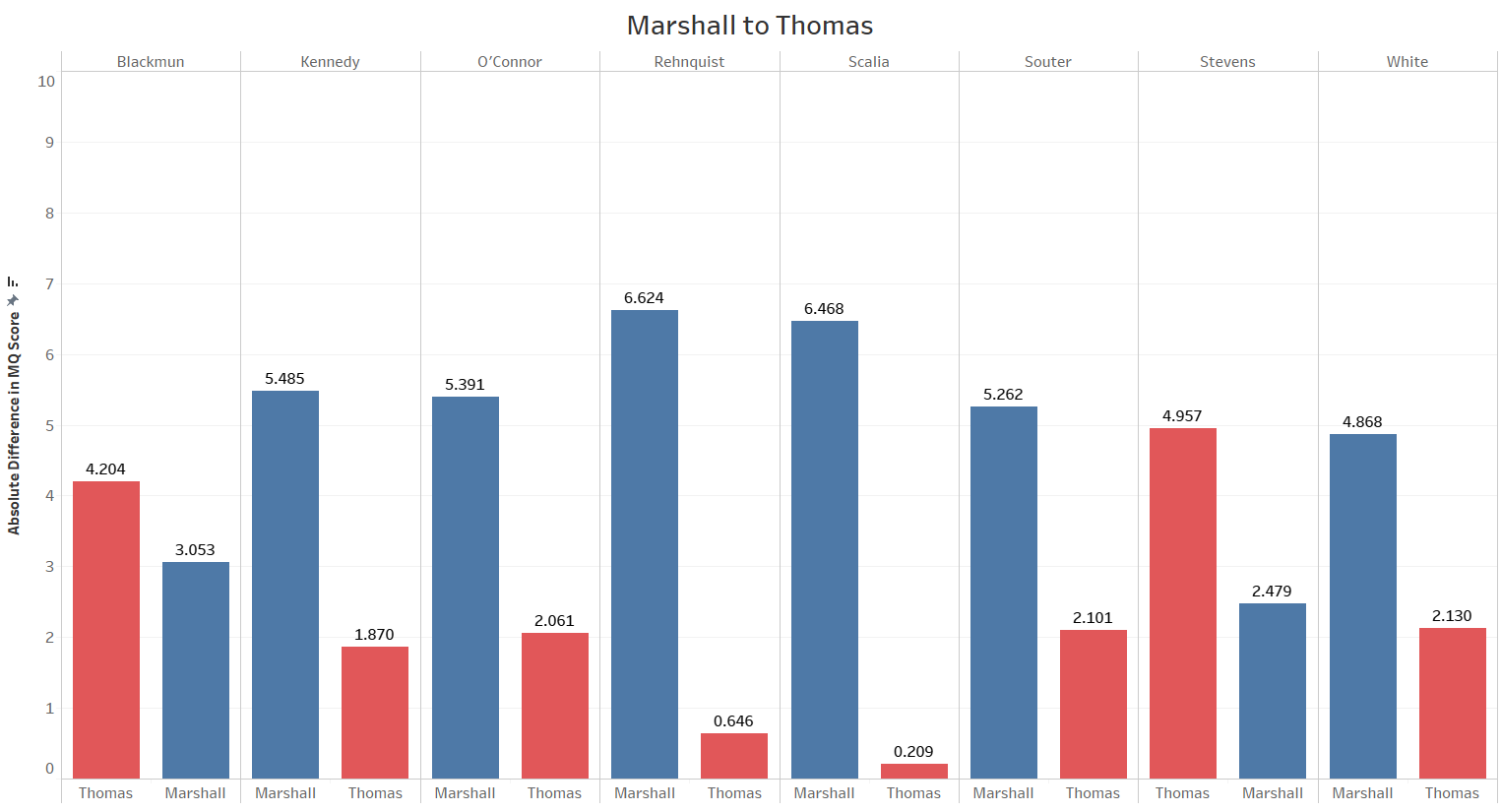
The subsequent graph reveals, in blue, the absolute values of the distances amongst Marshall and each and every of the 8 other justices on the court docket in Marshall’s previous expression (1990). And in red, it reveals the distances amongst Thomas and each and every of the other justices for the duration of Thomas’ 1st expression (1991).
Click on to enlarge.
Two of the justices that stand out with these distance steps are Chief Justice William Rehnquist and Justice Antonin Scalia. As both equally justices had been predominately conservative, they tracked closely to Thomas — which is apparent from the small distance benefit. On the other hand, these similar justices have the widest rating discrepancies from Marshall, who was the most liberal justice on the court docket at the time of his retirement. Marshall, like Ginsburg, sat on a predominately conservative court docket in his remaining years, and he was in the the vast majority only 67% of the time in his remaining expression. Thomas, in contrast, was in the the vast majority nearly seventy seven% of the time for the duration of his 1st expression.
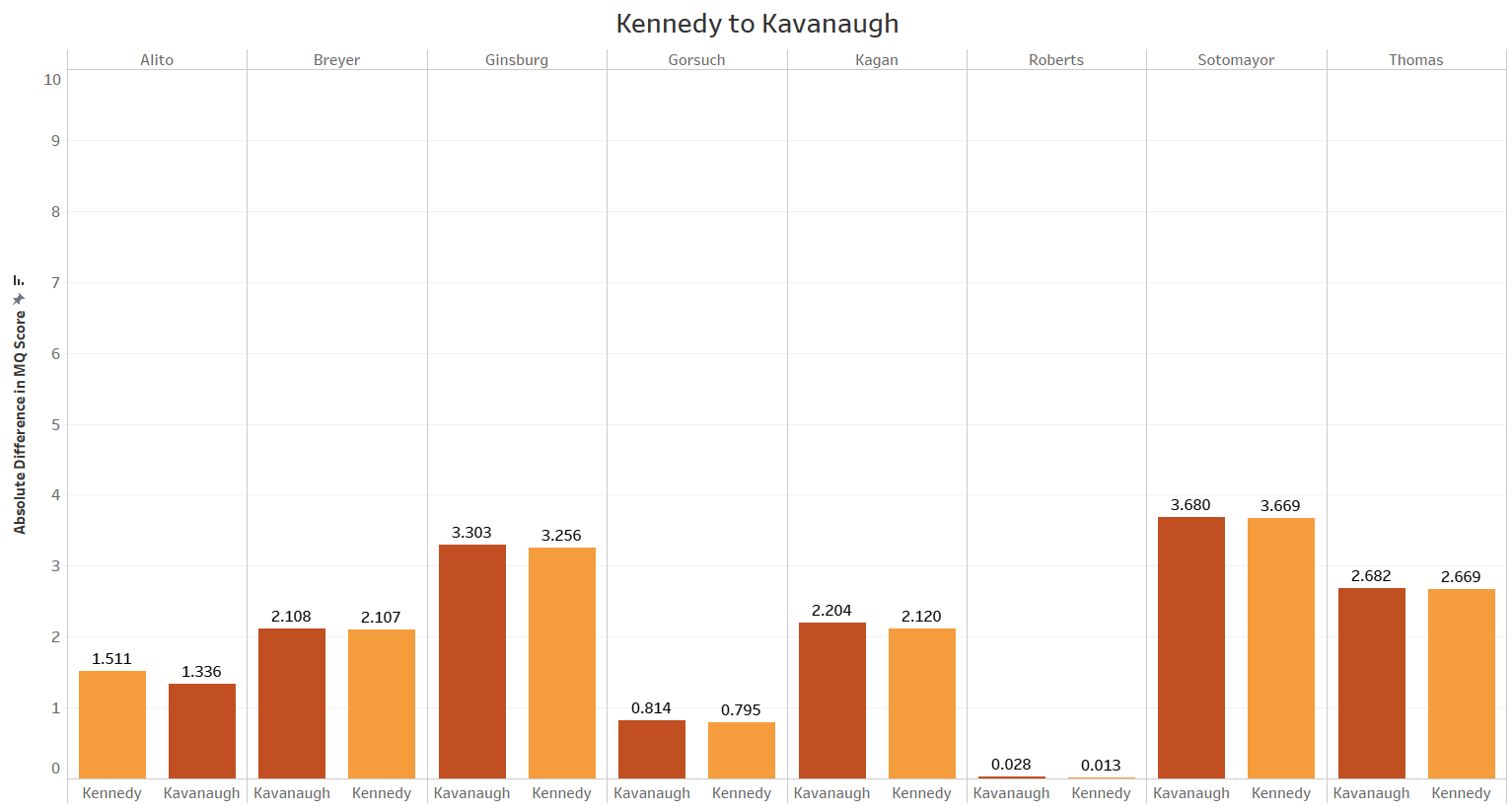
An analysis of a various Supreme Courtroom seat underscores the magnitude of the ideological shift from Marshall to Thomas. The subsequent chart compares the rating discrepancies of Justice Anthony Kennedy in his remaining 12 months on the court docket with the rating discrepancies of his successor, Justice Brett Kavanaugh, in his 1st 12 months. Kennedy was in the the vast majority 92% of the time in his remaining expression. He also tended to vote really conservatively that expression: He voted with the conservative justices in all fourteen 5-four choices that broke down together ideological strains. Kavanaugh was in the the vast majority 88% of the time in his 1st expression and was in seven conservative majorities in 5-four choices, when compared with just 1 celebration when he was the swing vote for the liberal justices. Not amazingly, then, Kennedy’s MQ rating discrepancies in his remaining expression keep track of really likewise to Kavanaugh’s in his 1st expression – an indicator that the shift from Kenendy to Kavanaugh did not drastically change the court’s ideological balance.
Click on to enlarge.
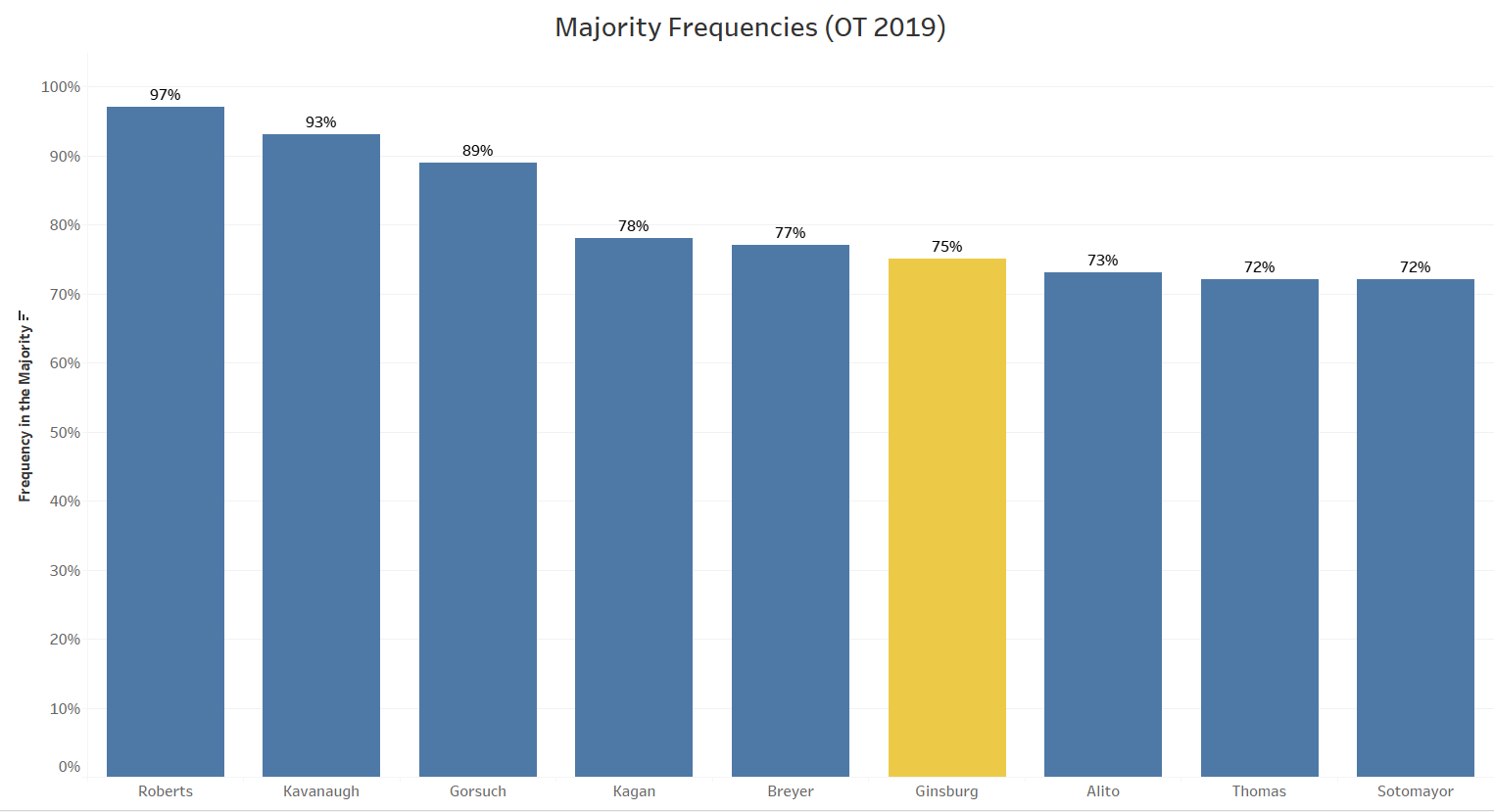
Wherever does Ginsburg in good shape into all of this? Like Marshall, Ginsburg is a liberal justice on a predominantly conservative court docket. Her 75% frequency in the the vast majority this past expression is on the small finish of the present-day slate of justices and is amongst those people of Marshall in his previous expression (67%) and Thomas in his 1st (seventy seven%).
Click on to enlarge.
Six of the justices slide into a narrow band of the vast majority frequencies amongst seventy two% and seventy eight% for OT 2019. Only Chief Justice John Roberts, Justice Neil Gorsuch and Kavanaugh slide outside of this band at the larger finish of the spectrum. Perhaps a lot more telling are the justices’ charges in the the vast majority in the court’s fourteen cases that had been made the decision 5-four or 5-three for the duration of the latest expression. The 5 a lot more conservative justices had been in the the vast majority in 10 of them. Roberts sided with the a lot more liberal justices in two others, and Gorsuch sided with the liberals in 1. The remaining 5-four determination, Ga v. Community.Resource.Org, bundled justices of mixed ideologies in the the vast majority. Ginsburg was in dissent in that scenario, generating her general frequency in the the vast majority of 5-four or 5-three choices this past expression only 21%.
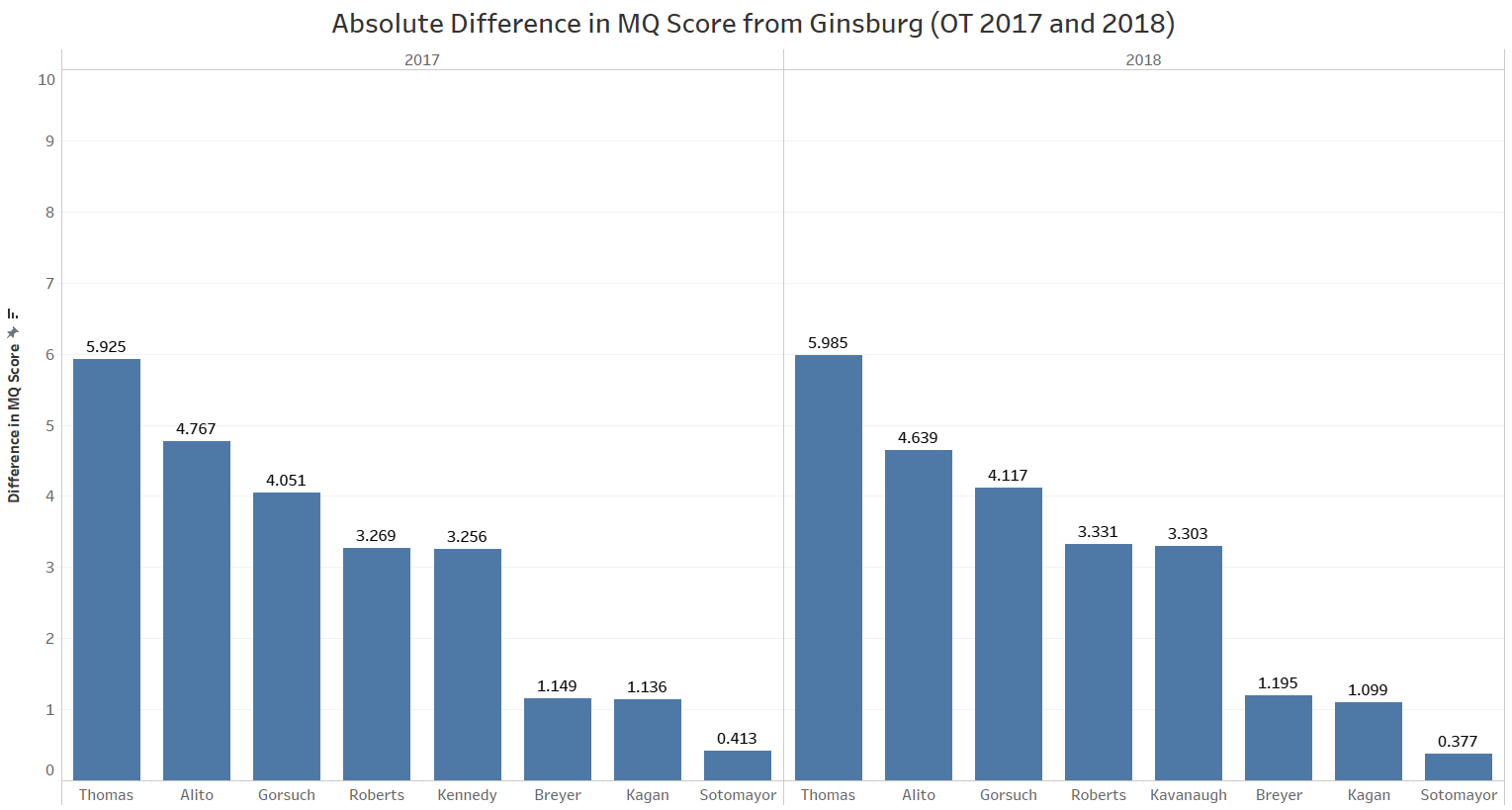
When we glimpse at Ginsburg’s MQ rating discrepancies from the other justices in excess of the two most latest phrases with launched scores, OT 2017 and OT 2018, we see her proximity to the liberal justices and distance from the conservative justices — which includes from the three conservative justices most frequently in the court’s majorities. Ginsburg’s distance from Kennedy in OT 2017 is correct on par with her distance from Kavanaugh in OT 2018. And both equally Kennedy and Kavanaugh had been just about triple the distance absent from Ginsburg as was any of the liberal justices.
Click on to enlarge.
This leaves a couple of feasible scenarios for the potential of the court docket relying on how prolonged Ginsburg remains.
Ginsburg needs to keep her place on the court docket until a new president is sworn in, not just elected, to ensure anyone other than Trump fills her seat. If Trump fills Ginsburg’s seat, probabilities are the justice will be at minimum as conservative as Roberts and Kavanaugh and will really maybe be nearer to edge of the conservative continuum, like Thomas and Justice Samuel Alito. A couple of Republican presidents have appointed justices who have drifted in the liberal course in excess of time, but this is not likely now specified the vetting that goes into nominations. A seismic shift from a Trump-stuffed Ginsburg emptiness would likely resemble the changeover from Marshall to Thomas.
If, on the other hand, Ginsburg had been to retire with a Democratic president in office, her seat would likely be stuffed by a justice who aligns most closely with Justices Stephen Breyer, Sonia Sotomayor and Elena Kagan. This shift would glimpse substantially a lot more like the 1 from Kennedy to Kavanaugh.
Only time will explain to which changeover we’ll face. The chance of Ginsburg remaining on the court docket for a further four years if Trump is reelected appears to be small. Ginsburg’s wellbeing in excess of the subsequent 5 months and the final results of the 2020 election, both equally for president and for the Senate, will likely dictate no matter whether the court docket usually takes an even sharper switch to the correct or no matter whether it remains at minimum fairly related to how it appears to be like nowadays.
This publish was originally printed at Empirical SCOTUS.
The publish Empirical SCOTUS: If Ginsburg had been to depart the court docket, her departure may resemble Thurgood Marshall’s appeared 1st on SCOTUSblog.


